Inject
A low-volume liquid or suspension passes through a clinically practical needle.

Polymer Science for Long-Acting Delivery
InSituGels develops injectable polymer platforms that transform from free-flowing formulations into localized depots after administration—enabling controlled, sustained drug release from a single injection.

01 / SCIENCE
In-situ-forming systems transform after administration through solvent exchange, temperature response, ionic interaction or molecular self-assembly. The resulting matrix can protect an active ingredient and control its release from days to months.
A low-volume liquid or suspension passes through a clinically practical needle.
Water, temperature or local chemistry triggers gelation or polymer precipitation.
Diffusion and matrix degradation shape exposure across the intended interval.
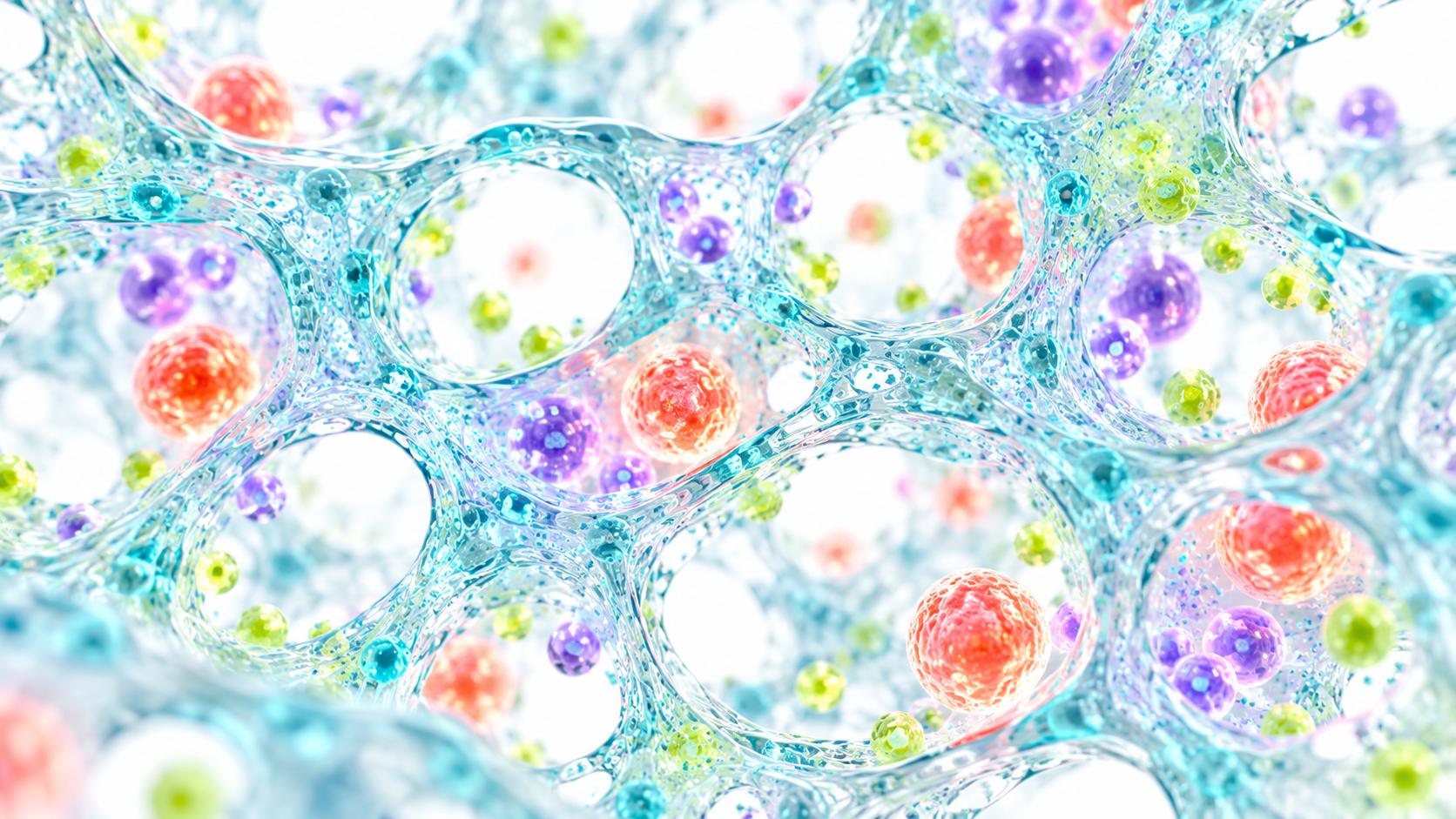
Polymer architecture, API properties and depot microstructure work as one system.
02 / PLATFORM LANDSCAPE
Biodegradable PLA, PLGA and PEG–PLA systems precipitate as solvent exits and tissue water enters. This family has the strongest commercial precedent for multi-month systemic delivery.
Poloxamer and degradable block-copolymer solutions gel near body temperature. They are attractive for aqueous processing and local delivery, with dilution and mechanical strength as key constraints.
PEG, hyaluronan, alginate and chitosan networks can form through crosslinking, pH or ions. Their flexibility suits localized therapy, while gelation reproducibility and residual chemistry require care.
03 / DEVELOPMENT
Success depends on more than gelation. The molecule, polymer, solvent, device and injection site must be developed together.
Dose, potency, solubility, stability and therapeutic window define the viable platform space.
Polymer identity, solvent exchange and API state determine early exposure and depot morphology.
Real-time and accelerated methods should resolve burst, diffusion and degradation phases.
Needle, injection force, volume and rate determine what actually forms in tissue.
04 / CONNECT
InSituGels is building a focused knowledge platform for polymer depots, formulation strategy and translational development.
hello@insitugels.com ↗